Author Archives: ICLMG CSILC

Canada and Criminalization in the War Over Land and Nature

Poster for the movie Flin Flon Flim Flam. Credit: Investigative MEDIA

By Jen Moore

Almost five years ago, while working as Latin America Program Coordinator for MiningWatch Canada, I was declared a threat to public order and security in Peru and barred indefinitely from the country. My crime, and that of similarly-accused U.S. documentary filmmaker John Dougherty, was working with Peruvian organizations to show a film critical of Canadian mining company Hudbay to communities affected by its open-pit copper Constancia mine. The film, Flin Flon Flim Flam, presents critical testimony on this company’s operations from Manitoba to southern Peru.

Our case needs to be understood in the context of social control, repression and criminalization1MiningWatch Canada et al., “HudBay Operations in Peru and Guatemala: Violence and Repression Found to Result from Mining Company Contracts with State Security Forces,” MiningWatch Canada, November 28, 2019: https://miningwatch.ca/news/2019/11/28/hudbay-operations-peru-and-guatemala-violence-and-repression-found-result-mining that communities and organizations living and working around the Constancia mine face regularly. Hudbay’s mine has given rise to numerous protests over unfulfilled agreements with communities, as well as environmental and social impacts. Community demonstrators have faced police repression and legal persecution at the hands of the Peruvian National Police, who had a security services contract with Hudbay at the time of these events. Such contracts have been common in Peru and are hotly criticized2EarthRights International, the National Coordinator of Human Rights in Peru and the Legal Defense Institute, “Report reveals contracts between Peru’s National Police and Extractive Companies,” EarthRights International, February 19, 2019: https://earthrights.org/media_release/report-contracts-perus-police-extractive-companies/ for putting police at the service of private interests, contributing to the high incidence of violent repression of legitimate protest, causing injuries and deaths.

Our case is part of a “concerted attack” throughout the Americas on environment and land defenders, “aimed at disciplining and quashing individuals and groups in diverse countries in the hemisphere where considerable gains have been made to stop or slow the accelerated expansion of this industry and the serious social and environmental impacts which it entails,” as MiningWatch and ICLMG wrote in the 2015 report In the National Interest?.3ICLMG and MiningWatch Canada, “In the National Interest? Criminalization of land and environment defenders in the Americas,” ICLMG, August 2015: https://iclmg.ca/issues/in-the-national-interest-criminalization-of-land-and-environment-defenders-in-the-americas/ This report examines how the law has been progressively turned against defenders to impose a destructive and often unwanted model of mineral extraction on communities and even on whole

countries. Using examples from Peru, Mexico, Guatemala, Ecuador and Canada, the report also illustrates how the Canadian government has played a strategic role through aid, diplomacy and trade policy to facilitate the massive expansion of Canadian mining interests in the region. Canada is exporting abroad the same extractive industry dependence that the Canadian settler colonial state was founded on and continues to perpetuate.

Even before we arrived in Peru in April 2017, we were defamed in the press as trying to “sabotage” Hudbay’s operations. During community screenings, police and Hudbay representatives questioned local community members about our presence, while police surveilled our movements. Following a screening in the city of Cusco, we were detained for four hours by more than 15 migration officers and plain clothes police who claimed they needed to verify our travel documents, but who sought to interrogate us instead.

The next day, Saturday, the Ministry of Interior issued a public communiqué declaring us to be a threat to public order, accusing us of inciting communities to violent protest against Hudbay’s mine, and stating that the company’s permits were in order. On advice from our lawyers that we were in danger of the authorities cooking up false charges and that we could continue the legal process from afar, we left Peru. On Sunday, Migration Services banned us from the country indefinitely. We never had the opportunity to defend ourselves and only became aware of this decision months later.

Peruvian courts have since found that these actions constituted grave violations of my rights, and that the decision to ban my re-entry to Peru is illegal and arbitrary. A 2019 decision further found that police and the Ministry of the Interior acted with bias as a result of the security contract between Hudbay and national police.

Despite this, and despite being a Canadian citizen and human rights defender working at the time for an organization that enjoys generous support of prominent human rights and legal organizations in both countries, Canadian officials utterly failed to provide meaningful support, going as far as to make false and misleading statements to UN bodies.

Canadian cooperation in the cover up for Hudbay

A new report from the Justice and Corporate Accountability Project (JCAP)4Charis Kamphuis, Charlotte Connolly, Isabel Dávila Pereira, Mariela Gutiérrez, Sarah Ewart, and Danielle Blanchard, “The Two Faces of Canadian Diplomacy: Undermining Human Rights and Environment Defenders to Support Canadian Mining,” Justice and Corporate Accountability Project, December 10, 2022: https://justice-project.org/2022/12/10/the-two-faces-of-canadian-diplomacy-undermining-human-rights-and-environment-defenders-to-support-canadian-mining/ analyzes hundreds of pages of government records obtained through access to information requests about Canada’s response before, during and after our detention. The report weighs up the response of Canadian officials to their own guidelines for supporting human rights defenders, Voices at Risk, and finds that the government failed miserably.

While MiningWatch’s appeals to Canadian officials – with support from many other organizations – received no reply, Canadian officials were obliged to reply to correspondence signed by four United Nations and three regional human rights bodies.

The UN letter expressed concern for my safety and sought information about Hudbay’s potential involvement in our criminalization. After a three-month delay, Canadian officials responded, avoiding the UN’s question about how it had implemented, or not, the Voices at Risk policy. Regarding the company’s role, they stated they were “not aware of any evidence that Hudbay Minerals was involved in the actions of Peruvian authorities in detaining and questioning Ms. Moore.” But this was both misleading and false.

In all of my communications with Canadian officials, including detailed letters endorsed by many other organizations, I provided information on how Hudbay personnel had questioned community members prior to our detention and on the company’s contract with police, which we believed – and which Peruvian courts have found since – led to biased police actions against John and I. Embassy officials also reviewed social media posts by Peruvian organizations making similar claims. On this basis and according to its own policies, Canadian officials should have exercised due diligence, but there is no evidence that they did. In addition, Duane McMullen, then Director General of Trade Operations and Trade Strategy for GAC, received an email from a Hudbay employee three days after our detention. This person expressed support for our criminalization by Peru, and this should have raised a red flag, but Canadian officials reported none of this in their response to the UN. JCAP concludes, “By protecting Hudbay and withholding the information referred to here, Canada not only failed to cooperate with the Special Rapporteur, it also undermined the Rapporteur’s ability to fulfill its mandate and take steps to protect a Canadian [human rights defender].”

Overall, the failures were numerous and systemic. They provide further evidence of how Canada’s clientelistic relationship with the mining industry corrupts its ability not only to fulfill its human rights obligations, but to hear the calls of environment and land defenders to abandon the extractivist economic model that causes so much harm and puts them in ever greater danger.


Jen Moore is now based in Mexico and an Associate Fellow with the Mining and Trade project at the Institute for Policy Studies.

Back to table of contents

Since you’re here…

… we have a small favour to ask. Here at ICLMG, we are working very hard to protect and promote human rights and civil liberties in the context of the so-called “war on terror” in Canada. We do not receive any financial support from any federal, provincial or municipal governments or political parties. You can become our patron on Patreon and get rewards in exchange for your support. You can give as little as $1/month (that’s only $12/year!) and you can unsubscribe at any time. Any donations will go a long way to support our work.panel-54141172-image-6fa93d06d6081076-320-320You can also make a one-time donation or donate monthly via Paypal by clicking on the button below. On the fence about giving? Check out our Achievements and Gains since we were created in 2002. Thank you for your generosity!


make-a-donation-button

Footnotes

What 20 Years of Injustice has Meant for Us

Mohamed Harkat (foreground) and Sophie Lamarche-Harkat (centre). Credit: rabble.ca.

By Sophie Lamarche Harkat

The following piece recounts the lives of Mohamed (Moe) Harkat and Sophie Lamarche Harkat in a nutshell for the past twenty years.

December 10, 2002. International Human Rights Day. A sudden arrest outside our apartment building in broad daylight under some bogus law no one knew about or understood. In the dark about the allegations and secret evidence. A call at my work announcing Moe’s arrest and detention. Being on the verge of passing out when I find out it is related to terrorism. My mother remembering the sound of fear and panic in my voice since that day. Being on the front page of every national newspaper, on every radio station and TV channel. Being portrayed as the most evil person on the planet. Being worried I might never see him again. Afraid he could be deported at any time.

The stress of having to find a lawyer, when everyone refuses to take on any case related to terrorism, and having to pay a huge retainer before anything even happens. Detention without charge for 3.5 years. One year in solitary confinement, hundreds of hours waiting to see hubby in isolation, no access to fresh air or the outdoors for six months. No Quran or anything to read for the first few months, one shower a week, no access to a razor. Feeling like a terrorist before your first court appearance because you look like Bin Laden since you are unable to shave. Constant struggles with the prison guards to have our rights respected. Inhuman conditions of detention. Being humiliated, degraded and targeted by the staff, as well as by the media and the court. Never knowing what’s coming next. Always in the dark about everything. Never being charged with a crime. Only allegations you cannot defend against. An informant that fails a lie detector test and another that has an affair with the Canadian Security and Intelligence Service (CSIS) agent. Countless hours in court and reading thousands of legal documents. Losing all confidence in the justice system.

Years of our lives going to waste. Having to leave my good government job because they are uncomfortable with my becoming a public figure speaking out against my own government and security certificates. Having to move in with my mother again because I’m jobless and broke. Having to pay and borrow thousands of dollars to pay legal fees. Husband kidnapped from the detention centre with some of the worst conditions in Canadian history only to be moved secretly in a private plane accompanied by Royal Canadian Mounted Police (RCMP) agents to Guantanamo North, a prison built in Kitchener specifically for Security Certificate detainees, who were never charged. Portraying it as Fantasy Island because they got to wear their own clothing – no more orange jumpsuits – but they are hours away from their families, denied visits, and forced to endlessly ask for their basic rights to be respected. Their own private jail but with no benefits. No one gave a damn!

After 3.5 years of detention, the best news comes along. Moe is released on bail to his family. One hour after his release, we all regret making that decision while we are sitting around the table discussing our new reality with the Canada Border Services Agency (CBSA) supervisor. Toughest conditions in Canadian history. A GPS bracelet around his ankle that didn’t come off for 7.5 years. A huge monitor tied to his belt that complements the bracelet. Surveillance cameras inside the home. Court appointed sureties with him at all times, seven days a week, 24 hours a day. I became a full-time jailer for my own husband. Prisoners of our own home. Not allowed to pass the property line. Reporters jumping the fence to take photos. Moe panicking because they are not ‘’pre-approved’’ to be in contact with him. Curfew on the property, cannot cook on the BBQ alone, must always be tied to a surety’s hip. CBSA calling in the middle of the night to check up on him. Reporting by phone to the CBSA. Phone intercepted and mail always monitored. Every visitor and family member (including my 80-year-old grandmother and newborn nephew) must be approved in advance before visiting. Several CBSA vehicles and officers parked in front of our home or in our own private driveway to monitor us. We get two to three pre-approved outings per week for up to four hours, you know… to buy toilet paper, medication, and stuff like that. Every location, street, road needs to be pre-approved in advance, often only to be rejected. Denied a birthday outing because we’ll have speeches and that’s too political. On a good day, only half a dozen CBSA officers follow us at the grocery store, restaurant, and while we are doing everyday mundane things. Officers sitting in a car for hours in front of my sister’s house while we visit the new baby. Nonstop communications on their walkie talkies describing our every move. Surrounded by more security than the Prime Minister. Always dressed up in uniforms with bullet proof vests and carrying weapons… you know in case some senior comes over to say “Hi.” This happened and Moe sweated his life away, afraid he was breaching his conditions. CBSA taking notes of every purchase. Attending a pap test with Moe sitting in the corner because he can never be left alone. We must share a public washroom or change room because he can never be left alone.

Being described as ‘’feisty’’ (over a hundred times) during court appearances because I turned back to give them the evil look or was breathing harder than usual. Can’t point in their direction as it “jeopardizes their security.” Wanting to yell at them so many times but can’t take that chance since I’m his main surety and his ‘’freedom’’ depends on it. Unexpected raid at our house, while I’m in the shower, that lasted over six hours with 13 or more CBSA, two Ontario Provincial Police (OPP), three RCMP officers, sniffing dogs (for narcotics, currency, and explosives). House and lives turned upside down just because CBSA could ‘’lose their powers’’ any day. Computer, texts and emails monitored, and the list goes on. Passing on a yellow light is considered a breach as it violates ‘good behavior.’ Simple U-turns considered suspicious because we are not allowed to use non-approved roads. CBSA officers following us to shows at the National Art Centre or to the movies, and simply enjoying themselves. Impossible for Moe to get a decent job to this day because CBSA agents like to park close by or monitor his every move. Still reporting in person 16 years later. At times, Moe wishes he was back in jail because it would be so much easier on everyone. Three Supreme Court challenges that were a complete let down. Several governments and ministers doing absolutely nothing, putting the file on the back burner or letting the process drag on. So many sleepless nights, we stopped counting.

Putting on hold buying a home because we have so many legal debts and both of us cannot get decent jobs after being demonized in the news for two decades. Putting on hold travelling and discovering the world. Not able to visit or see his mother and brothers for over 35 years. Starting a family late because we do not want them to live under jail-like conditions. Having multiple miscarriages and health scares because we’re both getting too old. Never-ending health issues because of the constant stress. Cloud of deportation over our heads that never goes away. Losing family and friends because they prefer to believe the government even if the evidence does not exist or is kept secret. Gaining thousands more supporters and new friends who believe in social justice and in a fair trial. Having doubts in the justice system but continuing to hope. That has been our lives for the past 20 years.

Take action at iclmg.ca/stop‑harkat‑deportation and justiceforharkat.com


Sophie Lamarche Harkat turned human rights activist overnight on December 10th, 2002. She has been fighting to save her husband from detention, deportation, to obtain justice and to protect human rights from Canada’s security certificate regime and national security apparatus since. They have and continue to live under a cloud of secrecy and deportation for the past 22 years.

Back to table of contents

Since you’re here…

… we have a small favour to ask. Here at ICLMG, we are working very hard to protect and promote human rights and civil liberties in the context of the so-called “war on terror” in Canada. We do not receive any financial support from any federal, provincial or municipal governments or political parties. You can become our patron on Patreon and get rewards in exchange for your support. You can give as little as $1/month (that’s only $12/year!) and you can unsubscribe at any time. Any donations will go a long way to support our work.panel-54141172-image-6fa93d06d6081076-320-320You can also make a one-time donation or donate monthly via Paypal by clicking on the button below. On the fence about giving? Check out our Achievements and Gains since we were created in 2002. Thank you for your generosity!
make-a-donation-button

An Excess of Democracy and the Case for Hope

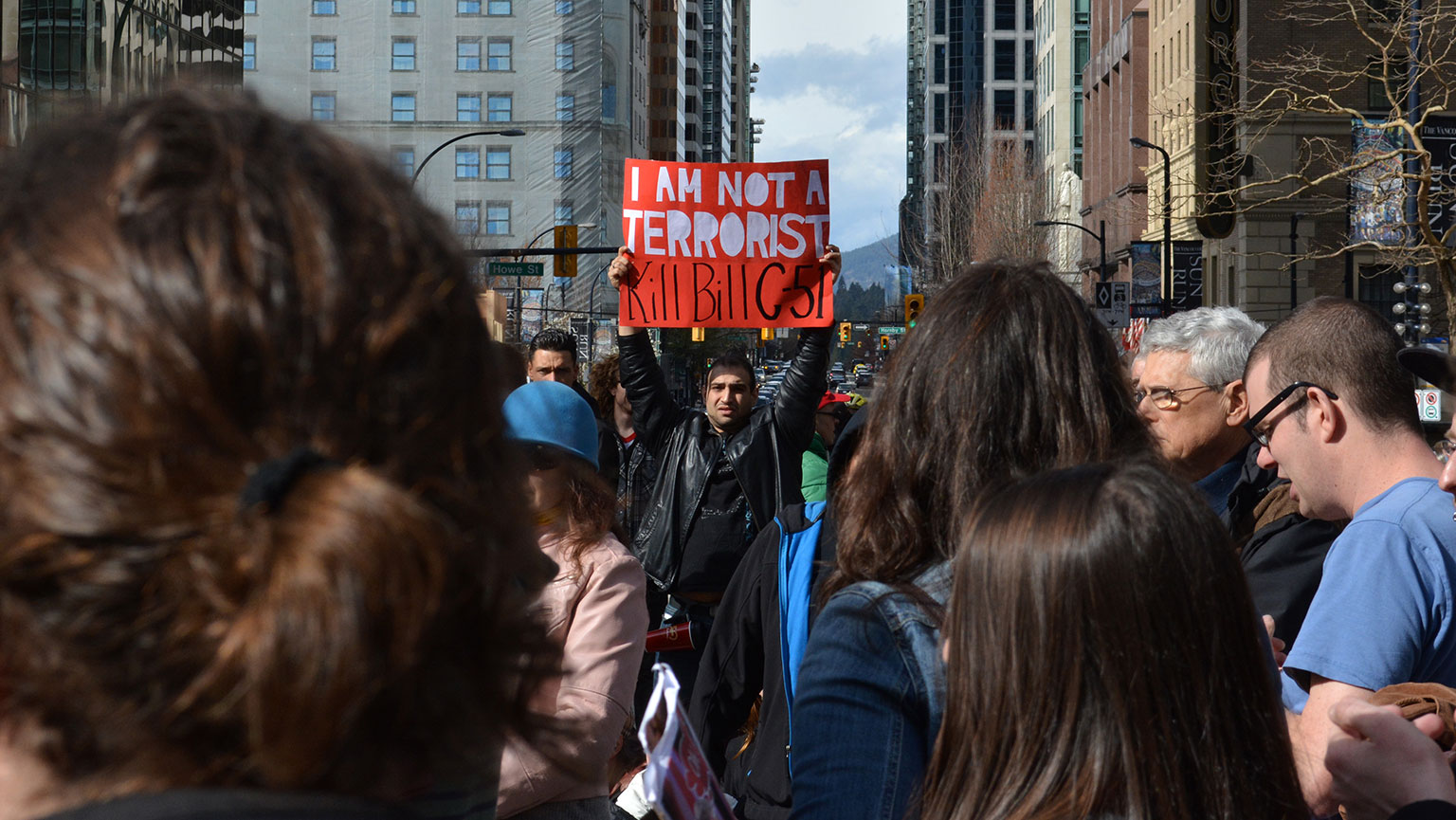
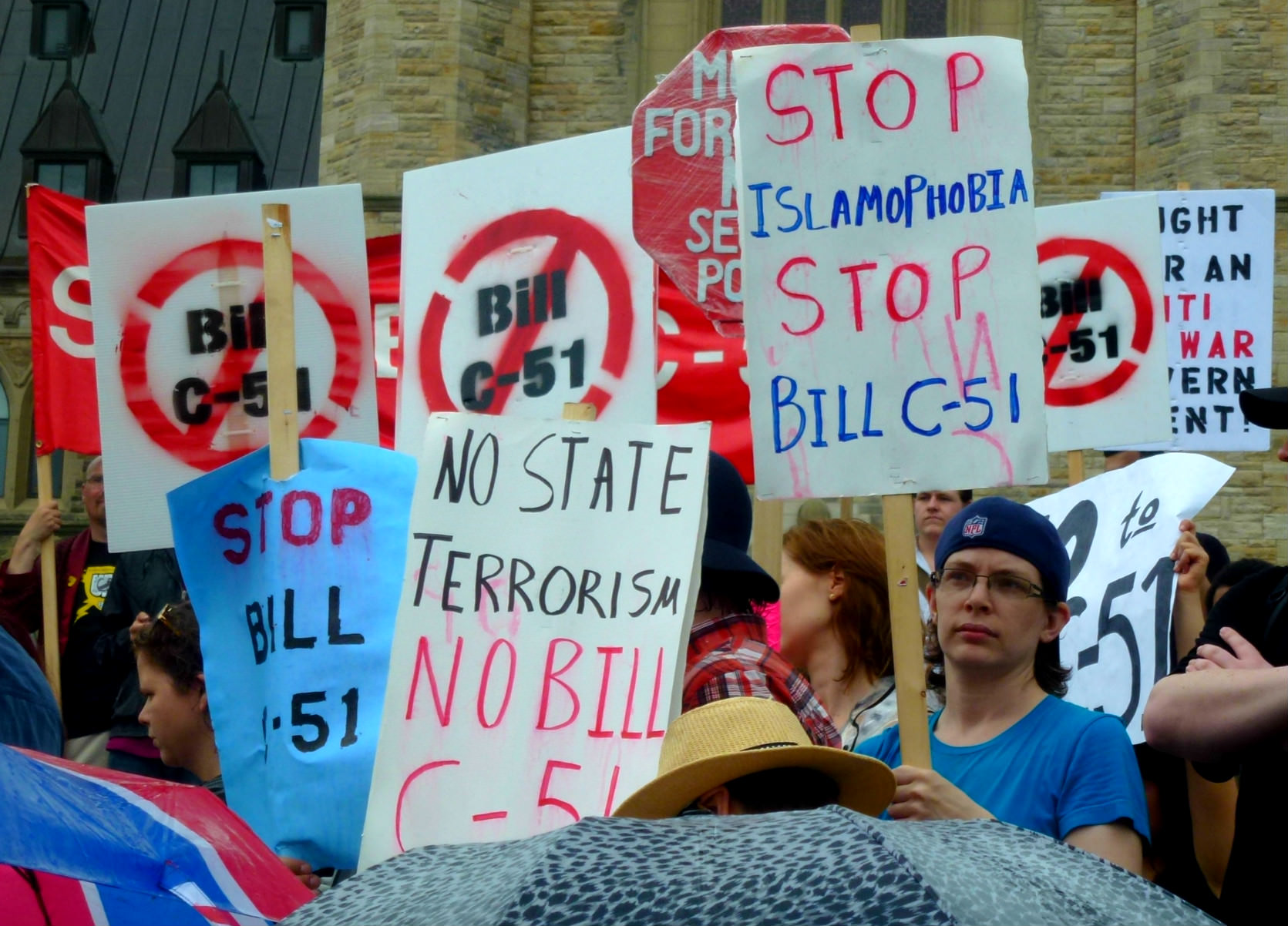
Protest against anti-terrorism laws in Edmonton, Alberta. Credit: Unknown.

By Matthew Behrens

After 20 years of working with the International Civil Liberties Monitoring Group on issues reflecting Canada’s insidious role in perpetrating the worst 21st century human rights abuses, I remain optimistic and hopeful. My faith is built on a key lesson that can never be learned enough: “We do,” as the late war resister David Dellinger reminded us, “have more power than we know.”

That scares the hell out of secretive state security.

While we’re rightfully concerned about each new iteration of repressive legislation and their increasingly elastic definitions of legality and morality, we seldom conclude that agents of state terror push such laws because they’re afraid of us inspiring outbreaks of democracy and resistance.

That fear is reflected in huge resources devoted to state security surveillance of social movements. During the early 1980s anti-nuclear and anti-cruise missile resistance, the RCMP was incredulous that spontaneous protests were popping up, and their search for a Soviet cell coordinating the whole movement was as fruitless as it was ridiculous. Fast forward to the pre-pandemic uprisings of 2020, and Jason Kenney, Justin Trudeau and John Horgan parroted the same notion that the Indigenous rights solidarity movement had been “hijacked” by evil outsiders.

The late civil rights leader Ella Baker once reflected that her organizer’s job “was getting people to understand that they had something within their power that they could use, and it could only be used if they understood what was happening and how group action could counter violence.”

In 1973, direct democracy and participatory politics led the planet’s leading power brokers (including members of Pierre Trudeau’s cabinet) to form the Trilateral Commission. Their 1975 report, The Crisis of Democracy,1Michel J. Crozier, Samuel P. Huntington and Joji Watanuki, “The Crisis of Democracy: Report on the governability of democracies to the Trilateral Commission,” New York University Press, 1975: https://ia800305.us.archive.org/29/items/TheCrisisOfDemocracy-TrilateralCommission-1975/crisis_of_democracy_text.pdf1 shivered with the conclusion that the social movements forcing real changes in those tumultuous times resulted from an “excess of democracy” that had to be reined in by the elites’ viewpoint that “the effective operation of a democratic political system usually requires some measure of apathy and non-involvement on the part of some individuals and groups.”

The Trilateral Commission concluded the dangers to “democracy” as they defined it — smooth functioning of Wall Street and Bay Street — come “not primarily from external threats […] but rather from the internal dynamics of democracy itself in a highly educated, mobilized and participant society. […] The problems of governance in the United States today stem from an excess of democracy. […] Needed, instead, is a greater degree of moderation in democracy.”

The fact that state agencies continually push for more secrecy and repressive tools is a testament to how scared they are of small groups of us who call their bluff, and who question their racism, threat exaggerations and incompetence. State security agencies couldn’t see a threat when a convoy of white supremacists came to overthrow the government because they were too busy trying to find links to Indigenous land defenders or Muslims or pacifists (they were also sharing information with their white supremacist brethren in the streets).

It’s helpful to reflect on our victories, however modest. Security certificates are no longer used because we made it politically impossible to do so: a regime consistently used for decades suddenly dried up. The 2007 Charkaoui Supreme Court of Canada decision was a landmark moment in which stigmatized, demonized, racialized, securitized human beings finally had some of their humanity recognized — they had Charter rights like the rest of us. That was the result of years of organizing and sticking to our principles.

A few years after Charkaoui, the head of CSIS lamented our role in turning these men into “folk heroes.” While this campaign showed we can seriously restrain state power, it also revealed how the hydra drew a few more heads, employing security certificate precedents to systematically integrate secret hearings into the inadmissibility stream for refugees and immigrants.

When we organized an anti-torture caravan in 2008 to support Abdullah Almalki, Ahmad El Maati and Muayyed Nureddin, the RCMP went into overdrive. Given that the state monitors our phones, they knew one of the men was unsure about joining. The night before we started, he learned his mother had been called in by secret police overseas and asked why her son might join the caravan. This act of intimidation angered him so much that he joined for a remarkably healing event as a whole community of non-targeted people provided loving support during the weeks we spent on the road. Later, we learned the RCMP opened a major surveillance and investigation project on the caravan labeled “Criminal Act by Terrorists.”2Matthew Behrens, “RCMP labels anti-torture caravan a ‘Criminal Act by Terrorists’,” rabble.ca, May 17, 2017: https://rabble.ca/columnists/rcmp-labels-anti-torture-caravan-criminal-act-terrorists/2

Labeling our work as “terrorist” is a reminder that, despite government, RCMP and CSIS assurances that they would never consider protests to be terrorism under Canada’s anti- terrorism laws, this remains standard operating procedure3Alex Boutilier, “List of protests tracked by government includes vigil, ‘peace demonstration’,” The Toronto Star, March 29, 2015: https://www.thestar.com/news/canada/list-of-protests-tracked-by-government-includes-vigil-peace-demonstration/article_21d103f1-571f-511a-a332-29668ef8623e.html3 inside Canada’s state security agencies, as it has been since long before Confederation. Those assurances didn’t stop the RCMP from monitoring Indigenous rights groups, like Idle No More, as alleged security threats under Project Sitka.4Matthew Behrens, “Trudeau’s Trumpishness bulldozes Indigenous rights,” rabble.ca, November 23, 2016: https://rabble.ca/columnists/trudeaus-trumpishness-bulldozes-indigenous-rights/4 Indeed, this equation of protest with terrorism is so ingrained within state security culture that no one even thought to redact the phrase from the caravan surveillance documents.

Ultimately, ICLMG and member groups show that principled resistance and a refusal to compromise on what’s right makes a difference. Far too many organizations still deal out members of the communities they are supposed to represent in the Good Muslim/Bad Muslim dichotomy. But the refusal to be afraid has marked ICLMG with Roch, Monia, and now with Xan and Tim.

I fondly recall an introductory meeting with someone who had borne the brunt of a decade of horrific terrorism slander as they related their case to Tim and Xan. Neither batted an extra eyelash. They listened, they asked questions, and they asked what they could do to help. We can learn a lot from that.


Matthew Behrens is a writer and social justice advocate who works with the targets of state security repression.

Back to table of contents

Since you’re here…

… we have a small favour to ask. Here at ICLMG, we are working very hard to protect and promote human rights and civil liberties in the context of the so-called “war on terror” in Canada. We do not receive any financial support from any federal, provincial or municipal governments or political parties. You can become our patron on Patreon and get rewards in exchange for your support. You can give as little as $1/month (that’s only $12/year!) and you can unsubscribe at any time. Any donations will go a long way to support our work.panel-54141172-image-6fa93d06d6081076-320-320You can also make a one-time donation or donate monthly via Paypal by clicking on the button below. On the fence about giving? Check out our Achievements and Gains since we were created in 2002. Thank you for your generosity!
make-a-donation-button

Footnotes