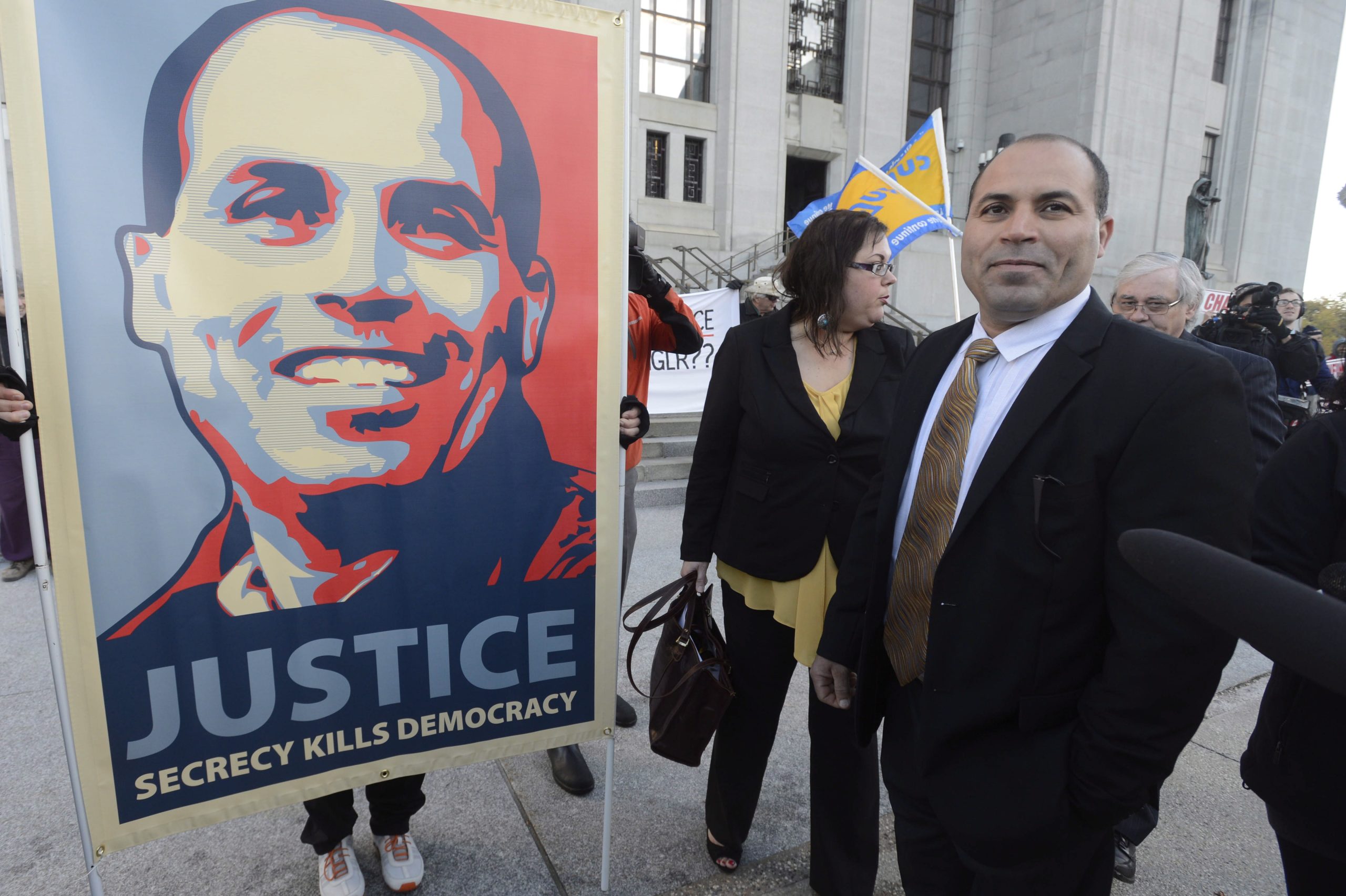
Mohamed Harkat (foreground) and Sophie Lamarche-Harkat (centre). Credit: rabble.ca.
By Sophie Lamarche Harkat
The following piece recounts the lives of Mohamed (Moe) Harkat and Sophie Lamarche Harkat in a nutshell for the past twenty years.
December 10, 2002. International Human Rights Day. A sudden arrest outside our apartment building in broad daylight under some bogus law no one knew about or understood. In the dark about the allegations and secret evidence. A call at my work announcing Moe’s arrest and detention. Being on the verge of passing out when I find out it is related to terrorism. My mother remembering the sound of fear and panic in my voice since that day. Being on the front page of every national newspaper, on every radio station and TV channel. Being portrayed as the most evil person on the planet. Being worried I might never see him again. Afraid he could be deported at any time.
The stress of having to find a lawyer, when everyone refuses to take on any case related to terrorism, and having to pay a huge retainer before anything even happens. Detention without charge for 3.5 years. One year in solitary confinement, hundreds of hours waiting to see hubby in isolation, no access to fresh air or the outdoors for six months. No Quran or anything to read for the first few months, one shower a week, no access to a razor. Feeling like a terrorist before your first court appearance because you look like Bin Laden since you are unable to shave. Constant struggles with the prison guards to have our rights respected. Inhuman conditions of detention. Being humiliated, degraded and targeted by the staff, as well as by the media and the court. Never knowing what’s coming next. Always in the dark about everything. Never being charged with a crime. Only allegations you cannot defend against. An informant that fails a lie detector test and another that has an affair with the Canadian Security and Intelligence Service (CSIS) agent. Countless hours in court and reading thousands of legal documents. Losing all confidence in the justice system.
Years of our lives going to waste. Having to leave my good government job because they are uncomfortable with my becoming a public figure speaking out against my own government and security certificates. Having to move in with my mother again because I’m jobless and broke. Having to pay and borrow thousands of dollars to pay legal fees. Husband kidnapped from the detention centre with some of the worst conditions in Canadian history only to be moved secretly in a private plane accompanied by Royal Canadian Mounted Police (RCMP) agents to Guantanamo North, a prison built in Kitchener specifically for Security Certificate detainees, who were never charged. Portraying it as Fantasy Island because they got to wear their own clothing – no more orange jumpsuits – but they are hours away from their families, denied visits, and forced to endlessly ask for their basic rights to be respected. Their own private jail but with no benefits. No one gave a damn!
After 3.5 years of detention, the best news comes along. Moe is released on bail to his family. One hour after his release, we all regret making that decision while we are sitting around the table discussing our new reality with the Canada Border Services Agency (CBSA) supervisor. Toughest conditions in Canadian history. A GPS bracelet around his ankle that didn’t come off for 7.5 years. A huge monitor tied to his belt that complements the bracelet. Surveillance cameras inside the home. Court appointed sureties with him at all times, seven days a week, 24 hours a day. I became a full-time jailer for my own husband. Prisoners of our own home. Not allowed to pass the property line. Reporters jumping the fence to take photos. Moe panicking because they are not ‘’pre-approved’’ to be in contact with him. Curfew on the property, cannot cook on the BBQ alone, must always be tied to a surety’s hip. CBSA calling in the middle of the night to check up on him. Reporting by phone to the CBSA. Phone intercepted and mail always monitored. Every visitor and family member (including my 80-year-old grandmother and newborn nephew) must be approved in advance before visiting. Several CBSA vehicles and officers parked in front of our home or in our own private driveway to monitor us. We get two to three pre-approved outings per week for up to four hours, you know… to buy toilet paper, medication, and stuff like that. Every location, street, road needs to be pre-approved in advance, often only to be rejected. Denied a birthday outing because we’ll have speeches and that’s too political. On a good day, only half a dozen CBSA officers follow us at the grocery store, restaurant, and while we are doing everyday mundane things. Officers sitting in a car for hours in front of my sister’s house while we visit the new baby. Nonstop communications on their walkie talkies describing our every move. Surrounded by more security than the Prime Minister. Always dressed up in uniforms with bullet proof vests and carrying weapons… you know in case some senior comes over to say “Hi.” This happened and Moe sweated his life away, afraid he was breaching his conditions. CBSA taking notes of every purchase. Attending a pap test with Moe sitting in the corner because he can never be left alone. We must share a public washroom or change room because he can never be left alone.
Being described as ‘’feisty’’ (over a hundred times) during court appearances because I turned back to give them the evil look or was breathing harder than usual. Can’t point in their direction as it “jeopardizes their security.” Wanting to yell at them so many times but can’t take that chance since I’m his main surety and his ‘’freedom’’ depends on it. Unexpected raid at our house, while I’m in the shower, that lasted over six hours with 13 or more CBSA, two Ontario Provincial Police (OPP), three RCMP officers, sniffing dogs (for narcotics, currency, and explosives). House and lives turned upside down just because CBSA could ‘’lose their powers’’ any day. Computer, texts and emails monitored, and the list goes on. Passing on a yellow light is considered a breach as it violates ‘good behavior.’ Simple U-turns considered suspicious because we are not allowed to use non-approved roads. CBSA officers following us to shows at the National Art Centre or to the movies, and simply enjoying themselves. Impossible for Moe to get a decent job to this day because CBSA agents like to park close by or monitor his every move. Still reporting in person 16 years later. At times, Moe wishes he was back in jail because it would be so much easier on everyone. Three Supreme Court challenges that were a complete let down. Several governments and ministers doing absolutely nothing, putting the file on the back burner or letting the process drag on. So many sleepless nights, we stopped counting.
Putting on hold buying a home because we have so many legal debts and both of us cannot get decent jobs after being demonized in the news for two decades. Putting on hold travelling and discovering the world. Not able to visit or see his mother and brothers for over 35 years. Starting a family late because we do not want them to live under jail-like conditions. Having multiple miscarriages and health scares because we’re both getting too old. Never-ending health issues because of the constant stress. Cloud of deportation over our heads that never goes away. Losing family and friends because they prefer to believe the government even if the evidence does not exist or is kept secret. Gaining thousands more supporters and new friends who believe in social justice and in a fair trial. Having doubts in the justice system but continuing to hope. That has been our lives for the past 20 years.
Take action at iclmg.ca/stop‑harkat‑deportation and justiceforharkat.com
Sophie Lamarche Harkat turned human rights activist overnight on December 10th, 2002. She has been fighting to save her husband from detention, deportation, to obtain justice and to protect human rights from Canada’s security certificate regime and national security apparatus since. They have and continue to live under a cloud of secrecy and deportation for the past 22 years.
Since you’re here…… we have a small favour to ask. Here at ICLMG, we are working very hard to protect and promote human rights and civil liberties in the context of the so-called “war on terror” in Canada. We do not receive any financial support from any federal, provincial or municipal governments or political parties. You can become our patron on Patreon and get rewards in exchange for your support. You can give as little as $1/month (that’s only $12/year!) and you can unsubscribe at any time. Any donations will go a long way to support our work. |