Credit: Tom Bastin/Flickr CC BY 2.0
Here is what we’ve accomplished in the first half of 2026,
thanks to your support:
Bill C-22, the Lawful Access Act
Bill C-22, the Lawful Access Act, was introduced on March 12, 2026. If adopted, this bill will lower the threshold for law enforcement agencies to gain access to personal data of people in Canada, as well as force companies to modify their systems to facilitate government surveillance and data collection. This would include forcing online platforms to retain metadata about users – revealing who they talk to, and when and how, where they travel and more – for up to six months, a practice previously struck down by EU courts for violating privacy rights. They could also be ordered to install backdoors that Pocketlabs, Meta, Apple, NordVPN and more warn will seriously weaken protections such as encryption, rendering it meaningless. Signal has even stated that it will leave Canada if C-22 is adopted. The orders could all be made in secret, under indefinite non-disclosure orders. All of this would have ramifications on the right to privacy, as well as freedom of expression and association. In a deeply undemocratic move, the government passed a motion stopping debate on dozens of amendments at Committee, and there was no recorded vote at 3rd reading in the House. C-22 is now in the Senate.
Since the bill was introduced, the ICLMG:
- Published a statement analyzing C-22 and calling for its withdrawal
- Presented at a webinar in French organized by the Ligue des droits et libertés.
- Organized a briefing and discussion for ICLMG members
- Testified against C-22 at the Public Safety committee on behalf of the Centre for Free Expression
- Met with MPs from all parties to raise concerns about the bill.
- Created actions to stop C-22:
- Been among 30+ civil society leaders & groups that signed on to a letter urging MPs to kill Bill C-22
- Wrote a joint press release: Privacy experts and civil liberties groups denounce the Liberal government’s shut down of much-needed debate on dangerous state surveillance bill C-22
Bill C-34, the Safe Social Media Act
On June 10, 2026, the federal government introduced Bill C-34, the Safe Social Media Act. The bill includes new requirements for online platforms and AI chatbot providers, age verification, and a new Digital Safety commission with broad, discretionary powers. Despite its title, the bill could potentially regulate a long list of services including cloud storage, online gaming, and message boards. C-34 repeats much of the contents of Part 1 of the last parliament’s unpassed Bill C-63, the Online Harms Act. Regarding our mandate, one similarity with C-63 is the (redundant and problematic) inclusion of “terrorist & violent extremist content” as an online harm alongside “violent content”. We have the same criticism we had with C-63: regulations around content that incites violence capture terrorist content and avoid the potential censoring of unpopular, unsavory or dissident content that can be falsely portrayed as extremist or terrorist (such as solidarity with Palestinians). A new aspect of C-34 is the introduction of a new definition of “terrorism and violent extremism” which is broader than what is currently in the Criminal Code. Since the tabling of the bill, we’ve:
- Attended a government briefing on Bill C-34
- Published our initial analysis of C-34 as related to our mandate: Much Needed Online Safety Rules Must Not be Used as Backdoor to Expand Terrorism, Violent Extremism Definitions
Help us fight for justice and human rights.
Please donate to the ICLMG!
Border & immigration bill C-12
The government tabled Bill C-12, the Strengthening Canada’s Immigration System and Borders Act, in October 2025, as a response to critiques of Bill C-2, the Strong Borders Act (now shelved thanks to civil society advocacy and public outrage), particularly around privacy violations. However, the bill replicated Bill C-2’s anti-migrant and anti-refugee provisions, such as: limiting the ability of individuals to claim asylum in Canada, in violation of international human rights law; allowing the mass cancellation or suspension of the processing of immigration documents (ex: visas and permanent residency cards) for entire groups of people, including individuals from certain countries; among others. With support of opposition parties and time limits put by the Liberal government on Senate committees studying the bill, Bill C-12 was adopted in March 2026.
Since January, the ICLMG:
- Created an action against Bill C-12 targeting the Senate.
- Testified against C-12 at Senate committee and submitted a brief that was used by several Senators to introduce amendments that were, unfortunately, rejected.
- Participated in Civil Society Senate Briefing on Bill C-12
- Signed onto a press release condemning the adoption of Bill C-12 as an attack on refugee and migrant rights in Canada.
Bill C-9: The Combatting Hate Act
Bill C-9, the Combatting Hate Act, was introduced in September 2025. The bill is aimed at preventing hate crimes but instead threatens the Charter rights and civil liberties of all people in Canada, including those communities that the government wishes to help protect. Bill C-9 will give police discretionary powers to decide whether certain symbols are hateful as well as determine the motivations and intentions of protesters, and would create new categories of buildings and infrastructure around which these new rules would apply. These new powers, combined with increased jail sentences, will significantly undermine free expression and dissent, sending a chill amongst those who would otherwise take part in protests. This bill is highly alarming, especially in the context of the crackdown on Palestinian solidarity and other movements. The government passed a motion to force debate to stop at committee on this bill as well. It became law in June.
Since last year, the ICLMG:
- Testified at the Senate Committee on Human Rights against Bill C-9
- Created two new actions calling the Senate to oppose Bill C-9 and shared them widely:
- An emailing campaign
- A call-in campaign
- Met with several partners to discuss, strategize and coordinate the fight against Bill C-9
- Signed onto the Joint Statement: “Senate Must Ensure Thorough Review of Bill C-9 to Protect Civil Liberties and Fundamental Freedoms”
- Submitted a brief to the Senate committee
- Reacted to the adoption of C-9: New federal hate crime legislation misses the mark, threatening free expression and other Charter rights: civil liberties coalition
- Signed onto a joint press release when C-9 received royal assent: 65 Civil Liberties, Human Rights, Faith and Community Organizations Express Serious Concern Following Passage of Bill C-9

Impacts of Countering Terrorism Financing
We continue to be heavily engaged in monitoring and addressing the impacts of Canada’s counter terrorism financing regime, especially its effects on civil society, civic space and international assistance. Since last December, we:
- Continued to engage in Finance Canada’s dialogue sessions with civil society, including:
- attending GoC-NPO dialogue sessions on de-risking and the humanitarian authorization regime
- providing feedback on draft terms of reference for a permanent Dialogue table
- Spoke on a panel regarding counter-terrorism financing, de-risking and the impact on the charitable and humanitarian sector at the Charity Resilience conference organized by the Canadian Muslim Public Affairs Council (CMPAC)
- Continued to regularly meet with the legal working group on counterterrorism and aid to discuss the impacts and ramifications of the Criminal Code’s humanitarian and international assistance authorization regime.
- Were awarded a grant from the TMFoundation for a research report and advocacy campaign on counter-terrorism financing, de-risking and impact on Muslim-led and humanitarian charities
- Presented at the Ottawa Civic Space Summit organized by Cooperation Canada on the panel: “Defend Humanity: When Closing Civic Space Constrains Humanitarian Response”
- Spoke at the Canadian Institute’s 25th Anniversary Anti-Money Laundering & Financial Crimes Conference on a panel about Canada’s 2026 Financial Action Task Force (FATF) evaluation, sharing ICLMG’s concerns about Canada’s approach to countering terrorist financing in the charitable sector and the need for reforms.
Combatting Islamophobia and anti-Palestinian racism
- We issued a statement regarding the Liberal government’s decision to eliminate the position of Special Representative on Combatting Islamophobia held by Amira Elghawaby.
- We issued a statement on the 9th “anniversary” of the Quebec Mosque shooting – ICLMG renews commitment to fight Islamophobia on National Day of Remembrance and Action against Islamophobia – and updated our Resource page on combatting Islamophobia.
- We attended initial meetings for the 2027 Canada-Palestine Symposium
- Our National Coordinator, Tim McSorley, received CMPAC’s 2026 Community Partner Award

Opposing Canada’s complicity in torture
- In early 2026, the new Syrian regime attacked Kurdish forces, leading the US to transfer/render detainees from North East Syria to Iraq, despite reports that Iraq remains a country rife with arbitrary detention, torture, a systemic failure to conduct fair trials, and execution in so-called national security cases. In March 2026, the United Nations Human Rights Committee called on Canada to repatriate 14 Canadian men and children (as well as two mothers of the children) in order to end what has in some cases been upwards of a decade of arbitrary detention under appalling conditions in north-eastern Syria and, more recently, in Iraq. On both occasions, we updated and reshared our action calling on Canada to repatriate all Canadians and mothers of Canadian children.
- June 26th was the United Nations’ International Day in Support of Victims of Torture. In recognition of that day, the ICLMG sent three letters to the Canadian government calling on them to stop their complicity in torture in three different cases – and we updated and re-shared our actions related to the first two cases:
-
- A letter to the Minister of Public Safety, calling on him to stop the deportation to torture proceedings against Mohamed Harkat once and for all. The letter contains important new developments that support allowing Moe Harkat’s to stay in Canada, including the recent decision from a Federal Court Justice ruling as unreasonable a Minister’s delegate decision stating that protection against refoulement to torture didn’t apply to Moe Harkat, despite his being a UN Convention refugee.
- A letter to the Minister of Foreign Affairs, calling on her to repatriate all Canadians arbitrarily detained in northeast Syria, and now in Iraq, in life-threatening conditions akin to torture. This letter also shares important updates including the call from the UN Human Rights Committee for Canada to repatriate all its citizens from NE Syria and Iraq, and the recent report from Human Rights Watch that warns about unfair trials, torture and the common use of death penalty in Iraq.
- A letter to the Minister of Justice, calling on the Canadian government to swiftly implement the apology and compensation we are confident the federal court will include in its upcoming decision regarding Abousfian Abdelrazik’s lawsuit against the government for its role in his illegal detention and torture in Sudan.
No-Fly List
In February 2026, the National Security and Intelligence Review Agency released a report which offers an unprecedented look at the internal workings of Canada’s no fly list regime, formally known as the Passenger Protect Program (PPP). NSIRA’s troubling findings reaffirm the fact that secret lists based on overly broad national security concerns are a recipe for rights violations. We sent an email and published a statement urging the Government to take immediate action to address the serious concerns with Canada’s No Fly List regime following this independent review.
Artificial Intelligence
- We continue to monitor the government’s actions re: AI and national security.
- We supported the launch of the “People’s Consultation on AI” in response to the government’s inadequate and rushed 30-day “consultation” that mostly took industry into account.
- We made our own submission to the People’s Consultation on AI.
Foreign interference
In February 2026, the ICLMG sent its comments to the federal government for their 30-day consultation on their proposed Regulations for the Foreign Influence Transparency and Accountability Act (which was part of Bill C-70, the Combatting Foreign Interference Act, which was rushed through Parliament in May and June 2024).

Anti-terrorism, national security & international bodies
We continue to do work at the international level. Since December, the ICLMG:
- Attended a meeting and sent comments to the Canadian Delegation for the review of Canada’s 7th report on the International Covenant on Civil and Political Rights (ICCPR)
- Participated in the CSO Coalition on Human Rights and Counterterrorism’ UN working group, analyzing and providing feedback on the UN Global Counterterrorism Strategy and the Coalition’s response.
And more!
- Nous avons écrit un article intitulé “Montée autoritariste : le Canada n’y échappe pas!” pour le plus récent numéro de la revue de la Ligue des droits et libertés (it will be available to read online and in English as well soon).
- The ICLMG joined more than a hundred prominent law and human rights experts, labour sector leaders and civil society organizations in warning that the proposed amendments to the Red Tape Reduction Act in Bill C-15 set Canada on a dangerous anti-democratic track.
- We published our News Digest every other week, which is distributed to thousands of people and has received numerous accolades.
+ Check out the News Digest archive if you’ve missed some of our issues.
+ If you know anyone interested in receiving it, send them an invite to sign up!
ICLMG IN THE MEDIA
The Carney government’s expanding power to identify Canadians online, access their data—and punish them, Graeme Gordon, The Hub, July 6, 2026
Coalition says feds need to ensure C-9 doesn’t create a ‘chilling effect’ on protests, Marco Vigliotti, June 19, 2026
Open Letter: Bill C-22, An Act respecting lawful access, The Internet Society, The Hill Times, Spring 2026
Bill to help authorities probe online activities raises widespread privacy fears, Jim Bronskill, The Canadian Press, 10 May 2026
Réforme migratoire : montée des critiques face aux risques pour la santé, Paloma Martínez Méndez, Radio-Canada, 1 May 2026
Carney’s Attack on Refugees and Migrants: Bill C-12 and cutting refugees’ access to healthcare pave a dangerous path forward, Rahul Balasundaram, The Leveller, 21 April 2026
Premières Nations, premières victimes de l’espionnage politique, Alexandre Popovic, Pivot, 20 April 2026
Criticism of Bill C-12 grows over risks to the health of refugees and migrants, Paloma Martínez Méndez, Radio-Canada International, 3 April 2026
Bill C-12 curbing asylum, immigration rights becomes law amid warnings of court challenges, Marie Woolfe, The Globe and Mail, 28 March 2026
Anti-hate bill that provoked bitter debate over religious freedom passes the Commons, Marie Woolfe, The Globe and Mail, 27 March 2026
I spoke to over 30 sources about Mark Carney’s first year as prime minister. This is the picture that emerged, Althia Raj, The Toronto Star, 13 March 2026
Documents reveal more about powerful forces behind push for warrantless lawful access, Ken Rubin, The Hill Times, 12 February 2026
Critics, pollsters warn Canadians are wary of AI, want government to set guardrails, The Canadian Press, 21 January 2026
Upholding human rights for Hassan Diab, Sandra Wiens, Quaker Concern, Winter 2026
Check out all coverage of ICLMG in the media here.
What we have planned for the rest of 2026!
We have our work cut out for us! This Liberal government is not only churning out bill after bill that restrict our rights and freedoms, it’s also using nearly every power and tool at its disposal to impose its unpopular and damaging agenda and erode the parliamentary process. In that context, we need all the help we can get!
Your support will allow us to continue our work of defending civil liberties in Canada from the negative impacts of anti-terrorism and national security laws and actions.
There will most likely be new challenges when the House of Commons comes back in the Fall, but right now here is our plan:
- We will take our fight against the state surveillance bill C-22 to the Senate
- We will push back against Bill C-34’s expansion of terrorism and violent extremism definitions that could restrict free expression, and addressing the lack of regulation on the use of AI in national security
- We will continue and deepen our work on the negative impact of countering terrorist-financing and de-risking on Muslim-led and humanitarian charities
- We will monitor the implementation of Bills C-9 and C-12 that are now law
- We will continue our work on the following:
- Advocating with lawmakers and officials to protect civil liberties from the overall negative impact of national security
- Protecting privacy from government surveillance, including facial recognition, and from attempts to weaken encryption, along with advocating for privacy law reform
- Advocating for restrictions on Canadian information sharing with the US, including the application of the US No Fly List in Canada
- Campaigning for the repeal of secretive and rights violating national security lists, such as the Terrorist Entities List and the Canadian No Fly List
- Pushing back against the rapid expansion of new security measures at the border and the false narrative depicting migrants and refugees as security risks
- Advocating for rights protection and accountability from border agencies, including by pushing for and monitoring the creation of a new CBSA and RCMP watchdog agency
- Opposing the escalating repression of free expression, dissent and protest in the name of “countering terrorism,” including the crackdown on protests in support of Palestinian human rights and against the genocide in Gaza.
- Fighting for Justice for Mohamed Harkat, an end to security certificates, and addressing problems in security inadmissibility
- Fighting for Justice for Hassan Diab and reforming Canada’s extradition law
- Calling for the return of Canadian citizens and the non-Canadian mothers of Canadian children, who remain indefinitely detained in Syrian camps and now Iraqi prisons.
- Pushing for restrictions on the implementation of new foreign interference laws
- Keeping you and our member organizations informed via the News Digest
- And much more!

If you think our work is important, please support the ICLMG!
We do not receive any funding from any federal, provincial or municipal governments or political parties so your support is essential to our work.
We are counting on people like you.
Please share widely in your networks via email and on Facebook + Instagram + Bluesky + Twitter
Thank you for your support in protecting civil liberties!
— Xan & Tim
PS: For what we were up to in the second half of 2025, click here!
PPS: For what we’ve been up to since ICLMG was created in 2002, check out our Achievements page!
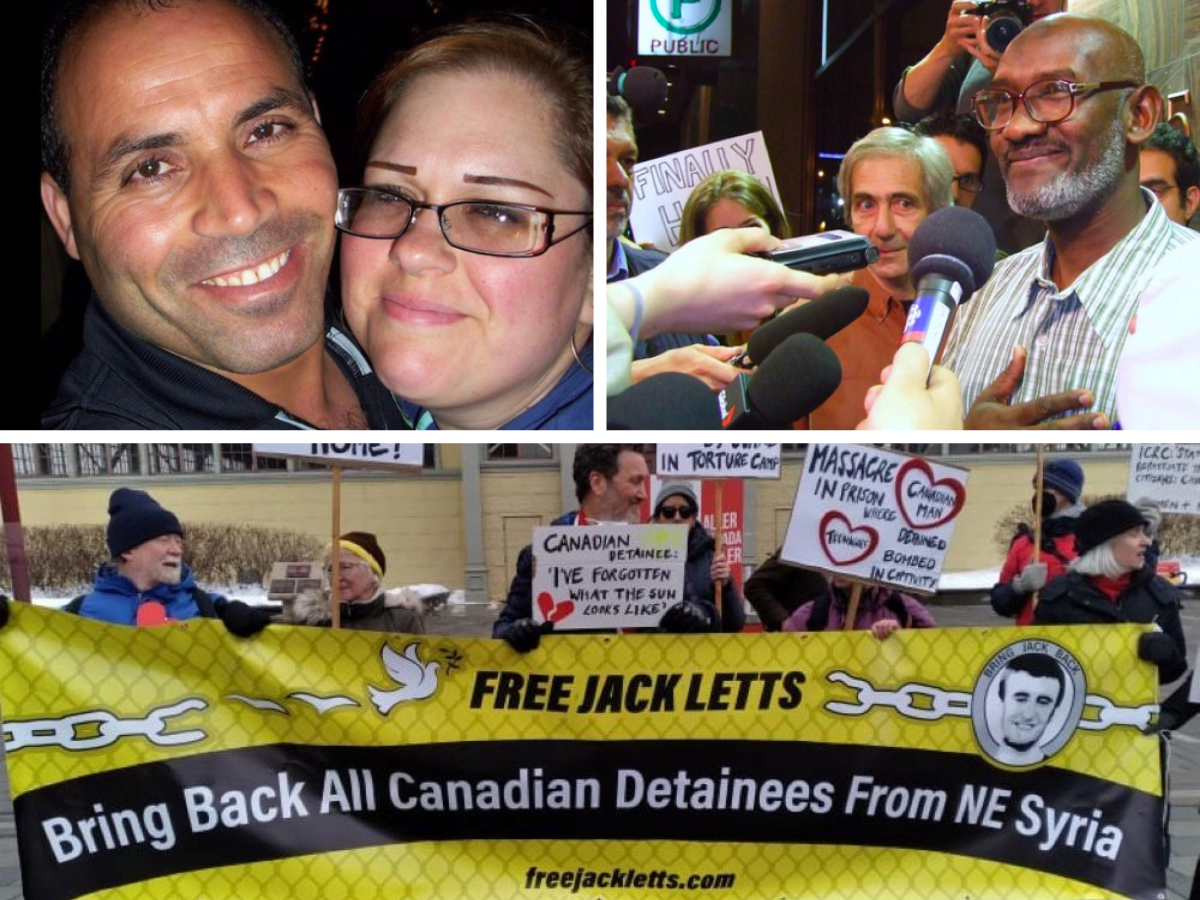 June 26th is the United Nations’ International Day in Support of Victims of Torture. In recognition of this day, ICLMG has sent three letters to the federal government calling on them to stop the Canadian government’s complicity in torture in three different cases: